News
In addition to contemporary art, my reading spans physics, mathematics, history, media, and other subjects across the natural sciences and humanities. I reflect my experiences and insights from life in my creative work—these may or may not be the stories behind my works.
Archived List
6 Reviews Included
The Desire of the Plants
——Zhu Zhu
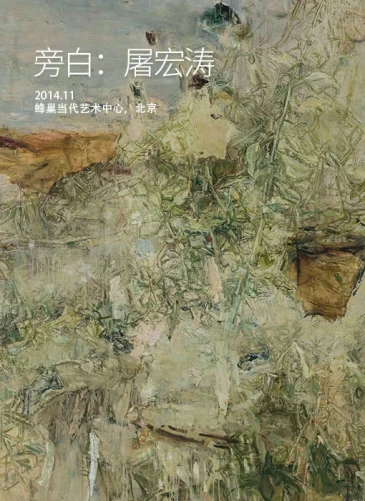
Zhu Zhu’s The Desires of Plants traces the transformation in Tu Hongtao’s creative work from the urban sensibility of desire and decadence to self-reflection and spiritual rebirth through the imagery of plants, all from a poetic perspective. He uses “negative space” to balance emotion and structure, allowing his brushwork to become more relaxed and free. The clamor of crowds is transformed into the growth of nature, symbolizing the extension of life force and the desire for freedom, revealing the artist’s creative metamorphosis from sensory indulgence to inner tranquility.
Plant Commentary
——Nima Lamu
Plants recur in Tu Hongtao’s recent works, shifting from anxious doll-and-crowd scenes expressing modern distress (“man and society,” “subject and others”) to abstract plant worlds where anxiety sinks into the undergrowth as foundation. He explores modern spiritual states: urban shock, intellectual alienation, spirit-material tension. Wild yet withered plants dominate, with ambiguous figures merging or marginalized, evoking isolation. Blending Western training and Chinese literati spirit, calligraphic lines structure flat scroll space, amplifying emotion over narrative. Rootless floating plants add surreal unease. Tu neutrally depicts release-repression conflict, moving beyond modernity toward human nature’s core.
From “Reality” to the “Truth” —On Tu Hongtao’s Recent Works
——Xu Sheng
Tu Hongtao’s recent works move from “reality” to “truth,” piercing beyond era’s anxiety, social desire, and distorted humanity to awaken the inner “human”—the intuitive, timeless existence between heaven and earth, embodying truth itself. Through empathetic painting and a ternary cycle (human, world, action), fusing Chinese Xinxue “mind is universe” with Heidegger’s poetic dwelling, he rejects binary art structures. Depiction becomes action: observing awakens viewers’ inner “human,” restoring wholeness beyond labels, echoing Wei-Jin’s rediscovery of human radiance and truth.
The Dreary World
——Zhu Zhu
Zhu Zhu’s critique explores Tu Hongtao’s portraits as a visceral response to a "dreary world" hollowed by capitalism. Through "entangled lines" and weathered surfaces, Tu transcends digital detachment to reclaim an authentic gaze. His work serves as a "re-exposure" of reality—not to offer salvation, but to reveal the profound, resigned truth of human ordinariness, transforming clinical pixels into windows of vital, breathing presence.
Portraits in His Forties
——Azure Wu
Azure Wu explores Tu Hongtao’s profound transition from social spectacles to the "inner space" of portraiture. By rejecting digital homogenization, Tu employs a rigorous process of deconstruction and reconstruction. His works—characterized by "rugged yet delicate" textures and a dialogue with both Western masters and Chinese literati—transform the canvas into a poetic force field, capturing the enduring truth of human existence.
( ! 需要翻译 ! )屠宏濤:在失控中觸碰單純(英文版翻译!!!!)
——Gu Cheng
缺少正文翻译替换后的英文版~缺少正文翻译替换后的英文版~缺少正文翻译替换后的英文版~缺少正文翻译替换后的英文版~缺少正文翻译替换后的英文版~缺少正文翻译替换后的英文版~缺少正文翻译替换后的英文版~缺少正文翻译替换后的英文版~缺少正文翻译替换后的英文版~缺少正文翻译替换后的英文版~缺少正文翻译替换后的英文版~缺少正文翻译替换后的英文版~缺少正文翻译替换后的英文版~缺少正文翻译替换后的英文版~缺少正文翻译替换后的英文版~缺少正文翻译替换后的英文版~
The Desire of the Plants
—— Zhu Zhu
Zhu Zhu’s The Desires of Plants traces the transformation in Tu Hongtao’s creative work from the urban sensibility of desire and decadence to self-reflection and spiritual rebirth through the imagery of plants, all from a poetic perspective. He uses “negative space” to balance emotion and structure, allowing his brushwork to become more relaxed and free. The clamor of crowds is transformed into the growth of nature, symbolizing the extension of life force and the desire for freedom, revealing the artist’s creative metamorphosis from sensory indulgence to inner tranquility.
Plant Commentary
—— Nima Lamu
Plants recur in Tu Hongtao’s recent works, shifting from anxious doll-and-crowd scenes expressing modern distress (“man and society,” “subject and others”) to abstract plant worlds where anxiety sinks into the undergrowth as foundation. He explores modern spiritual states: urban shock, intellectual alienation, spirit-material tension. Wild yet withered plants dominate, with ambiguous figures merging or marginalized, evoking isolation. Blending Western training and Chinese literati spirit, calligraphic lines structure flat scroll space, amplifying emotion over narrative. Rootless floating plants add surreal unease. Tu neutrally depicts release-repression conflict, moving beyond modernity toward human nature’s core.
From “Reality” to the “Truth” —On Tu Hongtao’s Recent Works
—— Xu Sheng
Tu Hongtao’s recent works move from “reality” to “truth,” piercing beyond era’s anxiety, social desire, and distorted humanity to awaken the inner “human”—the intuitive, timeless existence between heaven and earth, embodying truth itself. Through empathetic painting and a ternary cycle (human, world, action), fusing Chinese Xinxue “mind is universe” with Heidegger’s poetic dwelling, he rejects binary art structures. Depiction becomes action: observing awakens viewers’ inner “human,” restoring wholeness beyond labels, echoing Wei-Jin’s rediscovery of human radiance and truth.
The Dreary World
—— Zhu Zhu
Zhu Zhu’s critique explores Tu Hongtao’s portraits as a visceral response to a "dreary world" hollowed by capitalism. Through "entangled lines" and weathered surfaces, Tu transcends digital detachment to reclaim an authentic gaze. His work serves as a "re-exposure" of reality—not to offer salvation, but to reveal the profound, resigned truth of human ordinariness, transforming clinical pixels into windows of vital, breathing presence.
Portraits in His Forties
—— Azure Wu
Azure Wu explores Tu Hongtao’s profound transition from social spectacles to the "inner space" of portraiture. By rejecting digital homogenization, Tu employs a rigorous process of deconstruction and reconstruction. His works—characterized by "rugged yet delicate" textures and a dialogue with both Western masters and Chinese literati—transform the canvas into a poetic force field, capturing the enduring truth of human existence.
( ! 需要翻译 ! )屠宏濤:在失控中觸碰單純(英文版翻译!!!!)
—— Gu Cheng
缺少正文翻译替换后的英文版~缺少正文翻译替换后的英文版~缺少正文翻译替换后的英文版~缺少正文翻译替换后的英文版~缺少正文翻译替换后的英文版~缺少正文翻译替换后的英文版~缺少正文翻译替换后的英文版~缺少正文翻译替换后的英文版~缺少正文翻译替换后的英文版~缺少正文翻译替换后的英文版~缺少正文翻译替换后的英文版~缺少正文翻译替换后的英文版~缺少正文翻译替换后的英文版~缺少正文翻译替换后的英文版~缺少正文翻译替换后的英文版~缺少正文翻译替换后的英文版~